Yangon
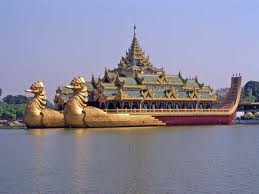 The city of Myanmar, has a unique charm with its old colonial buildings, Tree lined streets, busting local market and tranquil lakes. Interesting places to visit are the massive Shwedagon World famous Pagoda the original stupa was built over 2500 yrs at same place installing Buddhist relics inside it. Sule Pagoda an excellent landmark in the down town area. Chaukhtatgyi 72 meter long a reclining Buddha Image. One the Yangon riverfront its Botataung Pagoda said to house some Buddha’s hair relic. China town market has plenty of Chinese culture features Temples, houses and roadside food shops. National Museum a place housing numerous exhibits that are testament to the wealth of Myanmar Kings. Major tourist market in city is Bogyoke Market. Numerous souvenirs items are sold there to be memorials of the visit Myanmar.
Shwedagon
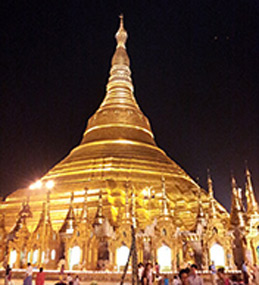 The Shwedagon pagoda is the most important attraction not just of Yangon, but of all of Myanmar. It is situated on Singuttara Hill, some three kilometers from the city center.
The pagoda dates back to the time of the Buddha, some 2,500 years ago. As temple legends tells, two Burmese merchants went to visit the Buddha and received eight of his hairs as relics. Though the merchants allegedly gave four hairs to regents of the different kingdoms on their way back to Myanmar, all eight hairs eventually showed up in Dagon, as the place was named then. In order to keep those eight hairs, the original Shwedagon pagoda was built.
The original pagoda, just nine meters high, is long gone, for unlike Angkor Wat in Cambodia, the Shwedagon pagoda has been “in use” ever since. Because it has continously been, and still is, a place of worship, it constantly has been extended, changed, renovated, rebuilt after fires and earthquakes, decorated according to the styles of the respective times, rebuilt again … and so on.
The main Stupa, more than 100 meters high, was built its present shape only in 1774. The Stupa, and many other buildings of the temple complex, are decorated with myriads of gems and gold. Thousands of pilgrims visit the site every day. Around the temple vendors sell ritual articles.
TWANTE.
PYAY (PROME)
Bago.
Shwemawdaw Pagoda
Shwethalyaung
Despite of its size the statue was lost from 1757 when Bago was destroyed until 1881. The British colonial masters found it, while they were building the railway track from Yangon to Bago.
Kyaikhtiyo Pagoda
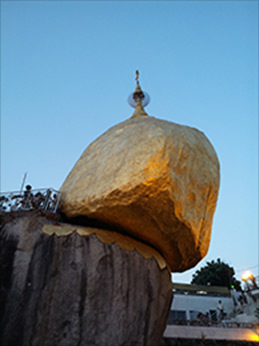 An enchanting journeys to the land of fantasy. Kyaikhtiyo Pagoda known to the world as Golden Rock is in the area of ancient kingdom of Suvannabhumi, meaning the golden land. This small 18-foot-high pagoda is built on a gilded boulder 25 meters in circumference balanced in what appears to be a very precarious position on a tabular rock jutting out from the Paung-laung ridge of the Eastern Yoma mountains. Lies 1,100 m above sea-level, 180 km from Yangon (approx 6 hours) by private minivan to the to the base camp call Kinponsakan, from here an upper staging point, the journey made in open truck on a recently built road from the base camp to the top of Rathedaung. From the here travelers must, at present, walk the final stage, approx. 1.5 km. As an easier alternative to walking, four porters at an extra cost can carry visitors in sedan chairs.
They provide ample space for hikers to rest, eat, bathe or recline. Pilgrims are not bothered by the heat, as the sun’s rays are unable to penetrate the jungle canopy covering the entire route. The legend of Kyaikhtiyo recounts that in the 11th century King Tissa received a strand of the Buddha’s hair from an old hermit on condition that it is enshrined in a pagoda built on a boulder resembling the hermit’s head. Thus the rock was found at the bottom of the sea and carried to the top of the mountain. The boulder was placed on the tabular rock and its delicate balance maintained by the precisely placed hair of the Buddha, enshrined in the small pagoda on top. This pagoda was named Khyaik-ei-thi-yo, which in the Mon language, means “pagoda borne on a hermit’s head.” A deep gorge separates the platform on the Paunglaung Ridge from the Pagoda standing on the gilded, hermit-head shaped boulder. The iron bridge spanning the gorge is used by male devotees to pay closer homage to the Pagoda and to guild the Golden Rock making it brighter and brighter in the sunlight.
Bagan
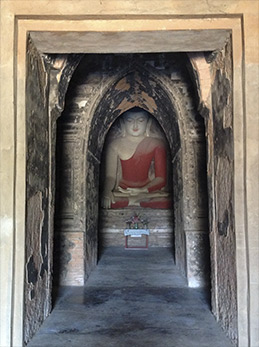 Bagan was founded in 849 on the banks of the Ayeyarwaddy river about 500 kilometers north of Yangon. Today it is only a small town … with a big past. Bagan once was the capital of the first realm in today’s Myanmar, whose area of dominance had roughly the extent of the present Burmese state. Bagan … today it is, strictly speaking, more of an archaeological site than a town, because more than 2,000 pagodas cover in mostly undamaged condition an area of about 40 square kilometers about the extent of the classical Bagan. Besides that, one finds in this area, which can be managed in walking stages, at least another 2,000 temple ruins. Even though Bagan is less famous than Angkor Wat in Cambodia, it is occasionally compared to the templecity of the Khmer concerning its archaeological importance.
Bagan’s peak time coincided with Myanmar’s architectural peak time in 1044 with Bagan King Anawratha’s ascension to the throne. Only one year after King Anawratha’s conversion to Buddhism in 1056 by a Mon monk, Shin Arahan, he went to war against the Mon town of Bago to gain possession of holy Buddhist scripts (the Tripitaka), which Mon King Manuba was unwilling to surrender voluntarily.After a siege lasting several months Manuba finally surrendered. Bago was destroyed and the Tripataka was transported to Bagan on the backs of 32 white elephants.But the holy Buddhist scripts were not the only trophies gained from the war. The Burmanese army took 30,000 Mons prisoners of war to Bagan, among them numerous craftsmen and artisans, who in following decades not only enriched, but even determined, Bagan’s culture. The Pagodas of the following period were almost exclusively built in Mon style.
The integration of the Mon artisans and craftsmen not only caused the pagodas to be built in Mon style, but also led to a so far in Myanmar unparalleled level of construction activity.
In 1287 hordes of Mongolian horsemen under Kublai Khan conquered Bagan. The town, at least the wooden, secular buildings, were mostly burnt down. Soon after, the realm of Bagan disintegrated into many, smaller kingdoms and fiefdoms. In latter times the town was not rebuilt.In 1975 a strong earthquake damaged and destroyed many smaller temples and even a number of large and massively built temples and pagodas were harmed.
Attractions in and around Bagan
MOUNT POPA.
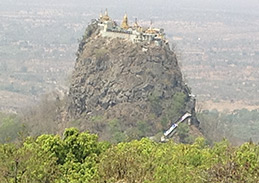 Often known as Myanmar’s Mt Olympus, Mt Popa is just a short trip from Bagan. Mt Popa, meaning ‘flower’ in Sanskrit, is an extinct volcano set amid beautiful hills. It is the most significant place for Nat spirit worship and has been for over 700 years.
Sale (Sa-lay)
Mandalay
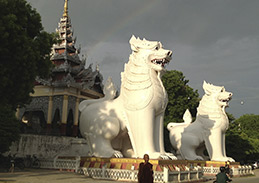 The last capital of Myanmar Kingdom, is now Myanmar’s second capital city. A city of Markets, Monasteries, Traditional art and craft centers and religious monuments, Mandalay is the economic and religious center of upper Myanmar. Places to visit around city are old Royal Palace, the last palace of Myanmar Kingdom, Mandalay hill, Panoramic View of city, has teak Monastery for Royal Monks, rest house for pilgrims and shrines, Kuthodaw Pagoda, well known as the world largest book since Buddhist scripture had been inscribed on 1774. Marble Slabs, Shwenandaw Monastery, a wonderful wood carving decorated building and antique materials preserved inside it. The place every visitor shouldn’t miss is Mahamuni Buddha Image. It was shifted from Rakhine State and built since Lord Buddha was still alive.
Other interesting places in the city are gold leaf making work, Tapestry work, and stone carving work, silk weaving work and Zaychotaw Market.
Mingun
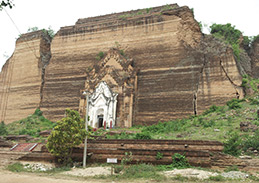 A morning 45 minutes long trip up river from Mandalay is Mingun. The great-unfinished Pagoda, the World Largest working Bell and Myatheintan different type of Stupa is places to visit riding on an ox cart like a villager.
Ava (Innwa)
Amarapura
11 km South of Mandalay is Amarapura. As it today prides itself on silk weaving, Shouldn’t miss the weaving works and shops of it, Mahagandayon Monastery, over one thousand monks make a solemn procession through the Monastery ground en route to their lunch. U Bein (1.2 km) long world oldest wooden bridge with Taungthaman Lake is unforgettable one for viewer. One may ride on hand rowing boat to other side or have a walk on it.
Sagain
Pyin Oo Lwin (Maymyo)
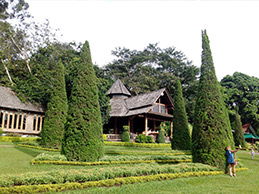
The Botanical Garden was first founded in the year 1915-16 by one British botanist named Mr. Roger who began collecting local plants and trees and cultivating them on 30 acres of land at the present site. It was only in 1919 that the Government gave official sanction to it.
The original area of the Botanical Garden was 170 acres of land and 70 acres of water totaling 240 acres. With a constant supply of sufficient spring water from the great lake nearby, the plan of the Garden was laid out on the design of Kew Gardens in England. In 1920 the Forest Department issued a notification No. 207 which declared the Botanical Garden as a forest reserve and placed it under the custody of the Department.
In several plots were planted 4840 trees mostly pine varieties, 575 different floral species and many exotic fruit, flower and shade trees from abroad that were acclimatized to grow in the Garden. Besides, vast meadows and several seasonal flower beds were arranged and hundreds of wild orchids from differarts of the country were collected and displayed in the Orchid Green House in the garden. The garden thus became one of the world class botanical gardens.
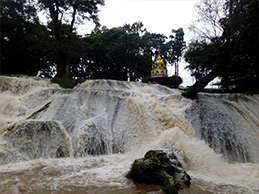
Pwe Kauk Fall
Monywa
Taunggyi
Taunggyi has no unique, architectural attractions, but is more of an attraction as a whole concerning its location on a steep mountain side and its atmosphere due to the Shan population. Furthermore, the surrounding mountain landscape with the Inle lake is exceedingly picturesque.
To reach Taunggyi you first have to fly to Heho, about 40 kilometers to the West, because the town itself does not boast an airfield.
Attractions around Taunggyi
Lake Inle
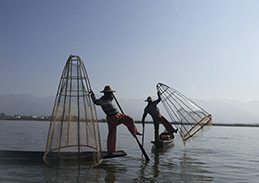 The unmistakably most important attraction in the area surrounding Taunggyi is Lake Inle. It begins about 30 kilometers south of the town and reaches about 100 kilometers from North to South, in some stretches becoming as wide as 2 kilometers. The extent of the lake in the third dimension is a lot less impressive. Although one usually expects mountain lakes to be rather deep, the floor of Lake Inle is on the average only about 4 meters below its surface. The lake is rich with fish, but what makes it unique is the way it is used for gardening. Inside the lake myriads of gardens have been created by building a surrounding wall and filling the inside area with loam from the floor of the lake. For the surrounding walls mostly water hyacinth were used. The resulting ground is extremely fertile and is mainly used for the cultivation of tomatoes and beans. In some parts of the lake these vegetable gardens are so extensive that the lake appears like a system of channels between plots of land.
Pindaya
Kalaw
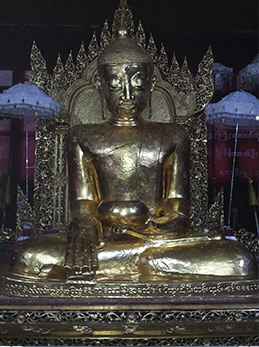 The favorite of the old British Hill Stations is a picturesque village surrounded by pine forest. It is also an ideal starting point for visit to the minority ethnic groups living in the neighboring villages on hill. Such as Palaung people, Taungyoe people, Danu people. One may see them in market day of Kalaw held once every five days. Pindaya Several kilometers east of Kalaw, en route to Kalaw from Heho airport, there’s a village called.
SITTWE AND MRAUK OO.
MYITKYINA.
PUTAO.
BHAMO.
MAWLAMYINE (MOULMEIN).
Myeik (Mergui Archipelago)
NGAPALI BEACH.
THANDWE (SANDOWAY).
NGWE SAUNG BEACH.
Golfing around
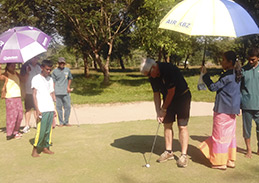 >Some major cities boast golf courses par excellence complete with modern facilities, which beckon travelling golfers from the world over. There are 36 (18-hole) courses and 68 (9-hole) courses in Myanmar. Recommended cities and towns are Yangon, Mandalay, Bagan, Taunggyi, Ngapali, Bago, etc. Some courses in Yangon and Taunggyi hosted Asia PGA tournaments recently.
It is said that some golf courses in Yangon have evoked admiration from international golfers. Value for money, golf tours may stand out soon from such popular trips here as Buddhist pilgrimage tours, culture tours, trekking tours, etc.
Worth a special mention among others is Yangon Golf Club. Established since 1909 and located just about an hour’s drive from Yangon, the club has been a usual haunt of many a golfer both from home and abroad throughout the past century. It’s also a birthplace of Myanmar’s finest golfers.
Balloons Over Bagan
The balloon is guided by gentle winds not exceeding 15 mph, allowing passengers a serene and bird’s-eye view of ancient temples drifting by using his skill the pilot is able to guide the balloon to a gentle landing on the banks of Ayeyarwaddy River, or in an open field, where the crew and the celebratory glass of champagne will be on hand.
The Balloon over Bagan service operates twice daily early in the morning just before sunset and late in the evening just before sunset between late October and pril.
Leave a Reply